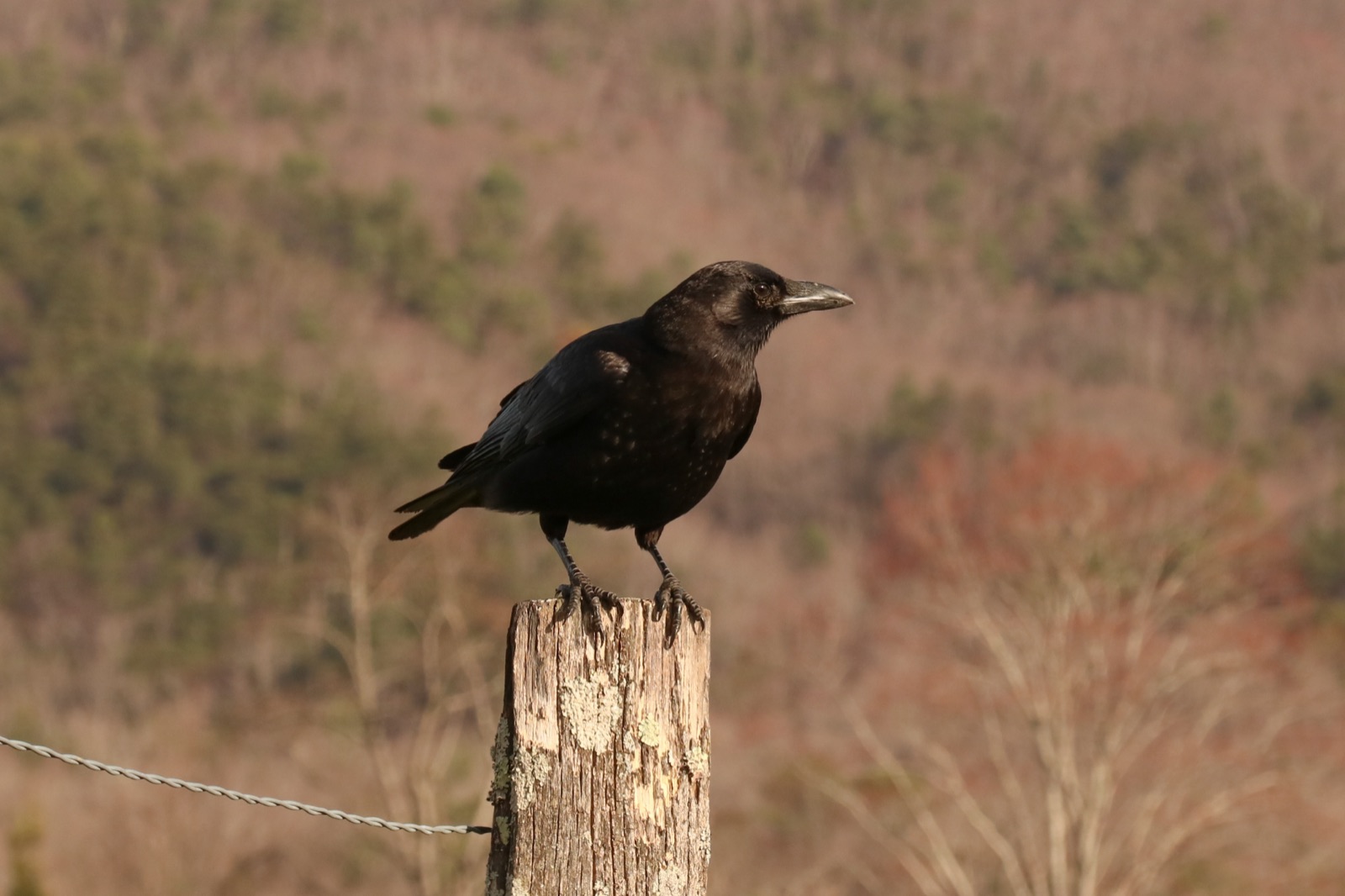
Direct answer
What crow calls mean in the field
A useful hunting routine tells one coherent story and then leaves room for real crows to answer. Crows inspect from trees and from the air, so concealment and a plausible sound source matter at least as much as vocal detail.
| Call or cue | What it communicates | Best context | Main risk |
|---|---|---|---|
| Standard harsh caw | General long-distance presence and contact; changes in duration and intensity can alter the message. | As the basic manual note for locating crows or beginning a low-pressure contact exchange during a legal season. | The word caw describes a family of notes, not one fixed cadence. Replaying an identical phrase can sound mechanical. |
| Territorial presence series | An advertisement that a crow or family group is present and the area is occupied. | When local birds are already vocal and a restrained counter-caw fits the existing exchange. | A territorial reply can keep birds at the boundary instead of bringing them closer. Do not describe every answer as commitment. |
| Double short caw alert | An alert or call-to-arms pattern associated with territorial chases and recruiting family members. | Sparingly when a visible threat story or active crow response makes an alert phrase plausible. | Escalating to alarm without a believable visual context can cause crows to inspect from a safe distance instead of closing. |
| Mobbing rally calls | Collective defense. Crows may gather, circle, dive, and call around an owl, hawk, eagle, or other perceived threat. | As part of a brief, visually plausible mobbing setup during a legal season and only where decoys or call methods are lawful. | Mobbing birds focus intensely on the source area. Poor concealment or obvious movement can end the response immediately. |
| Juvenile begging call | A young bird soliciting attention or food from family members. | Primarily for identification and as an occasional family-context note, not as an all-season primary call. | Fish Crows also sound nasal. Confirm range, pitch, and surrounding voices before treating a nasal call as an American Crow juvenile. |
| Subsong, rattle, and clicks | Close social communication with context that is less certain than the familiar long-distance caw. | Mostly as a sound to recognize around settled family groups or perched birds, not a long-range attention routine. | Do not assign a precise meaning to every rattle or click; even specialists note that much of the repertoire remains context dependent. |
Vocabulary & use
Crow calls, one by one
Standard harsh caw
Natural vocalization- Sound
- A strong, rough caw commonly delivered in a short series with visible pauses.
- Meaning
- General long-distance presence and contact; changes in duration and intensity can alter the message.
- When it fits
- As the basic manual note for locating crows or beginning a low-pressure contact exchange during a legal season.
- How to make it
- Use a crow call or voice to make two to four full notes with uneven natural spacing, then listen before answering again.
- Likely response
- A crow may counter-caw, turn toward the source, remain on a lookout perch, or ignore the sound.
- Do not miss
- The word caw describes a family of notes, not one fixed cadence. Replaying an identical phrase can sound mechanical.
Territorial presence series
Natural vocalization- Sound
- Measured caws projected across a territory, sometimes exchanged with neighboring birds.
- Meaning
- An advertisement that a crow or family group is present and the area is occupied.
- When it fits
- When local birds are already vocal and a restrained counter-caw fits the existing exchange.
- How to make it
- Match the approximate pace of one natural phrase without copying every reply. Turn the call slightly so the sound has direction rather than uniform broadcast.
- Likely response
- Nearby crows may answer from fixed perches or move to a higher vantage point before deciding whether to investigate.
- Do not miss
- A territorial reply can keep birds at the boundary instead of bringing them closer. Do not describe every answer as commitment.
Double short caw alert
Natural vocalization- Sound
- Short caws delivered in pairs, with less space inside each pair than between pairs.
- Meaning
- An alert or call-to-arms pattern associated with territorial chases and recruiting family members.
- When it fits
- Sparingly when a visible threat story or active crow response makes an alert phrase plausible.
- How to make it
- Make two quick short notes, pause, and repeat once. Keep it distinct from a continuous panic series.
- Likely response
- Family members may answer or move toward a lookout position; wary birds may remain outside the opening.
- Do not miss
- Escalating to alarm without a believable visual context can cause crows to inspect from a safe distance instead of closing.
Mobbing rally calls
Natural vocalization- Sound
- Excited, repeated alert caws and varied calls used to recruit others around a predator.
- Meaning
- Collective defense. Crows may gather, circle, dive, and call around an owl, hawk, eagle, or other perceived threat.
- When it fits
- As part of a brief, visually plausible mobbing setup during a legal season and only where decoys or call methods are lawful.
- How to make it
- Begin with one short alert phrase, pause for natural replies, and build only if real crows join the exchange.
- Likely response
- Crows may arrive high, circle, land in surrounding trees, or call from outside the setup while assessing the threat.
- Do not miss
- Mobbing birds focus intensely on the source area. Poor concealment or obvious movement can end the response immediately.
Juvenile begging call
Natural vocalization- Sound
- A higher, more nasal call made by immature crows and sometimes confused with a Fish Crow.
- Meaning
- A young bird soliciting attention or food from family members.
- When it fits
- Primarily for identification and as an occasional family-context note, not as an all-season primary call.
- How to make it
- Use a thinner, nasal tone and limit it to a short phrase inside a broader family-group story.
- Likely response
- Adults may answer or investigate during family season, while unrelated winter birds may show little interest.
- Do not miss
- Fish Crows also sound nasal. Confirm range, pitch, and surrounding voices before treating a nasal call as an American Crow juvenile.
Subsong, rattle, and clicks
Natural vocalization- Sound
- A quiet, improvised mix of hoarse coos, soft caws, rattles, and clicks; crows may also make a sharp bill clack.
- Meaning
- Close social communication with context that is less certain than the familiar long-distance caw.
- When it fits
- Mostly as a sound to recognize around settled family groups or perched birds, not a long-range attention routine.
- How to make it
- Study verified recordings and keep any imitation low and irregular. The sound should not be projected like a hail call.
- Likely response
- Close crows may remain engaged socially, but the note has no dependable attraction result for distant birds.
- Do not miss
- Do not assign a precise meaning to every rattle or click; even specialists note that much of the repertoire remains context dependent.
Seasonal context
When the message is believable
Family-group period
Use ordinary contact caws and listen for juveniles or multiple family voices. Keep alarm routines brief and tied to a believable source.
Fall movement
Scout travel lines and give one contact series from concealment. Watch for crows using a high tree as an inspection point.
Winter roost pattern
Work the edges and feeding routes rather than disturbing the roost itself. Large groups can have many natural callers, making restraint more credible than competing volume.
Field sequences
Two restrained ways to build the conversation
These are decision frameworks, not guaranteed formulas. Shorten, soften, or stop when the animal gives new information.
Sequence 01
Contact and answer
One or more crows are heard on a legal-season travel or feeding route
- Give three measured harsh caws from complete concealment.
- Wait for a full natural reply instead of calling over it.
- Answer once with two caws at similar volume if the bird turns or moves closer.
- Remain silent while the crow reaches an inspection perch or circles the opening.
Stop or change when: The bird is approaching, has settled at a lookout point, begins warning from a safe distance, or departs after identifying the setup.
Sequence 02
Brief mobbing story
A lawful setup includes a plausible visible predator and crows are active nearby
- Begin with one double-short alert pair.
- Add a brief four- to six-note mobbing phrase only after a natural crow answers.
- Pause to let arriving birds recruit others and inspect the visual source.
- Use one softer rally phrase if the group drifts but remains engaged.
Stop or change when: Crows are circling or landing within sight, alarm from outside the setup without closing, or human movement has been detected.
Before the first note
Field setup
- Hide overhead movement and face shine; crows often examine the caller from above or from a lookout tree before coming lower.
- Place any lawful visual decoy where an arriving crow can see it without staring directly at the hunter.
- Keep the sound source close to the visual story—contact crows with crow decoys, or alert crows around a plausible predator setup.
- Plan a safe field of fire that accounts for low circling birds, roads, buildings, livestock, partners, and non-target species.
Read the animal
What the response is telling you
- A natural crow answers with similar cadence and begins moving from perch to perch toward the source.
- One bird takes a high lookout while others circle or approach lower, showing coordinated inspection.
- Calls become faster and multiple crows join, consistent with rallying or mobbing rather than simple contact.
- Birds remain far out, give harsh warnings, or leave in a direct line after a close look, signaling that the setup has been detected.
Common errors
What makes the setup less believable
Running nonstop distress or fight sound
Real crow exchanges contain listening gaps. Continuous noise prevents natural birds from shaping the conversation and makes a fixed source easier to inspect.
Hiding at ground level but not from above
A crow approaching from a high angle can see faces, hands, and an open blind that would be concealed from a ground animal.
Assuming crow call methods are uniform nationwide
Federal rules let states prescribe crow seasons and methods within limits, and refuges or other properties can add stricter restrictions.
Rules & ethics
Verify before the hunt
American Crows are federally protected migratory birds, and crow hunting is conducted only under state laws and regulations authorized by 50 CFR 20.133. States set seasons, methods, and limits within the federal framework; Hawaii has no crow take under that rule, and refuges or other properties may be stricter. Verify the current state season, permitted manual or electronic calls, firearms or archery rules, land restrictions, and non-target identification before hunting.
Hunting-call laws vary by state, species, season, land type, and device. Verify the current wildlife-agency regulations for the exact hunt before using any recorded, amplified, or electronic call.
Electronic-call rules checklist →Questions hunters ask
Crow calling FAQ
How many caws should I make before listening?
Two to four measured notes are enough to begin a contact exchange. Pause long enough to hear a distant answer and watch for an approaching lookout.
Do all crow calls mean the same thing?
No. Crows alter note length, intensity, spacing, and phrase shape for contact, territorial exchanges, alerts, family communication, and mobbing.
Are electronic crow calls legal?
The answer depends on the current state and property rules. Some jurisdictions allow them for crows and others restrict them, so verify the exact hunt rather than generalizing from waterfowl or predator rules.
Research trail
Sources and further reading
Biology and call context were synthesized into original copy from the following references.