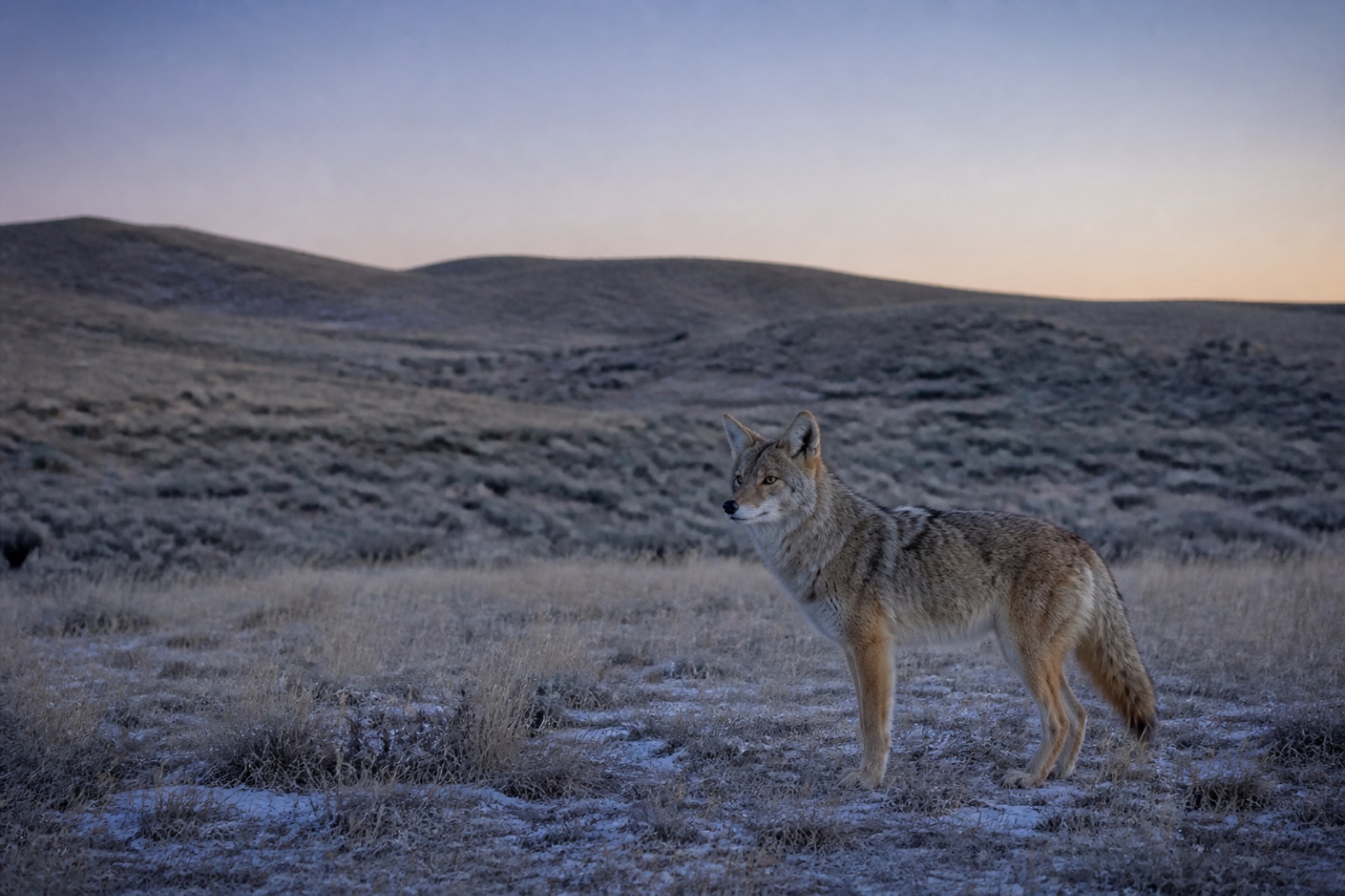
There is no honest universal minute mark for a coyote calling stand. A nearby animal crossing open prairie can reveal itself sooner than a coyote threading a wooded hollow, yet either may stop, watch, or circle downwind before the caller sees it. Weather, terrain, pressure, source message, and local coyote movement all change the useful observation window.
Plan stand length as a decision process rather than a countdown. One experienced caller recommends staying at least 30 to 45 minutes, based partly on observing how pressured, GPS-collared coyotes approached; treat that as practitioner advice, not a universal rule. Set a planned minimum, identify reasons to extend, and finish with deliberate silence while protecting the downwind side.
What to carry into the field
- No fixed stand time fits every habitat, season, sound, or coyote; use conditions and evidence instead.
- Dense cover, broken terrain, wind, and distant source areas can justify a longer observation window than close open cover.
- A vocal answer, movement, fresh alarm, or a likely downwind circle is a reason to watch—not automatically a reason to call again.
- End with a quiet scanning period and clear the area visually before standing or walking to the caller.
Field principle
Why the clock cannot decide for you
Stand-time advice often sounds precise because a number is easy to remember. The animal does not share that schedule. A coyote may begin outside the call's practical range, travel around a drainage, wait for another coyote, or use cover that hides most of the approach. Conversely, a nearby animal can arrive while the caller is still adjusting equipment.
Calling sound changes the decision too. A social howl may produce a delayed vocal exchange or a silent territorial check, while prey distress can trigger food investigation from a different part of the home range. Treat the first sound as the beginning of an observation, not the start of a promise. A stand that produces no visible animal can still supply useful information about wind, access, and local response.
Field principle
Build the observation window from habitat and travel
Estimate where a coyote could have heard the call and how it could reach the source. Open country may offer long sight lines but also allow an animal to stop far away and inspect. Timber, brush, crops, folds, and creek bottoms reduce visibility and create slower concealed routes. Wind can mask sound, move scent, and encourage a wider circle, so practical travel matters more than map distance alone.
Choose a minimum watch that is long enough to stop you from leaving impulsively, then name extension triggers before calling. Those triggers might include a distant answer, birds or livestock reacting along an approach lane, a fresh track at the source, or conditions that require a cautious downwind route. Avoid publishing your personal minimum as a universal formula; log it as a hypothesis to test in that habitat.
Field principle
Know when to extend, stay quiet, or end
Extend the stand when evidence suggests the encounter is still developing: a reply changes position, a coyote appears but holds in cover, or the only credible approach is long and concealed. Extra sound is not always part of the extension. Once an animal has the source located, silence and steady scanning often reveal more than another sequence.
End when the wind contaminates the likely cover, unsafe people or domestic animals enter the area, visibility no longer supports positive identification, or the setup has exhausted its planned window without new evidence. Moving to a fresh stand can be productive, but never let stand efficiency override a known animal still working downwind or a safe recovery from the position.
Field principle
Use a quiet finish and a disciplined exit
The final silent period is part of the stand. Scan the downwind edge, the nearest cover, low ground, fence lines, and any rise that offers a view of the source. A coyote that never vocalized may be standing where it can inspect before committing. Resist packing equipment while still watching; small movement can expose the caller at the end of an otherwise sound setup.
Before standing, unload or otherwise make the firearm safe as appropriate, signal a partner with the agreed human method, and inspect the route to the caller. Account for raptors, livestock, pets, and other hunters that distress sounds may have attracted. Afterward, record the habitat, wind, sound, visibility, evidence, and actual duration so future stand plans come from local observations rather than internet folklore.
Practice block
The condition-based stand timer
- Map hearing cover, likely travel lanes, the visible downwind arc, backstop, people, roads, livestock, and domestic-animal risk.
- Choose a minimum observation window for this setup and write the habitat evidence behind it instead of borrowing a universal number.
- List three extension triggers and three stop triggers, including wind failure, unsafe activity, and loss of positive-identification conditions.
- Finish with deliberate silence, clear every approach lane before moving, and log what happened for the next stand in similar cover.
Questions readers ask
How long to call coyotes FAQ
How many minutes should a coyote calling stand last?
An experienced caller recommends at least 30 to 45 minutes after watching pressured, GPS-collared coyotes take time to approach. Treat that as a practitioner baseline, not a universal cutoff. Adjust for sound range, approach cover, wind, visibility, pressure, local guidance, and any response signs.
Should a coyote stand be longer in thick cover?
Often it deserves more observation because a coyote can travel and circle without being seen, but thick cover is not an automatic timer setting. Sound range, wind, terrain, source placement, and the size of the cover all matter. Keep the closest lanes and downwind edge under observation from the first sound.
How long should I wait after the last coyote call?
Long enough to make the silence intentional rather than an immediate pack-up. Scan every likely approach and the downwind side, then clear the area before moving. The appropriate quiet finish changes with cover and evidence; its purpose is to catch a silent late approach and prevent an unsafe exit.
Research trail
Sources and further reading
This guide draws on the behavior, calling practice, safety, and equipment context relevant to its subject from the references below.