Direct answer
What mallard calls mean in the field
Read wing angle and direction before adding sound. If a flock is already holding a line toward the decoys, calling can add noise without solving a problem; if birds begin to slide away, one clean cue is easier to evaluate than continuous calling.
| Call or cue | What it communicates | Best context | Main risk |
|---|---|---|---|
| Single hen quack | A basic mallard contact note and the foundation for most manual mallard calling routines. | For close-working birds, a quiet finishing cue, or practice before adding longer strings. | A quack is not a command. Repeating it every second can become mechanical, especially over calm water. |
| Descending hen series | A natural extended call that provides a biological model for greeting-style hunting sequences. | As a moderate-distance contact series when birds are visible and not already committed to the setup. | Do not begin every sequence at maximum volume. A real hen's series can be conversational as well as loud. |
| Greeting or hail series | A hunter-built attention and contact routine based on the hen's descending quack series. | When a flock is at moderate distance and needs to notice or reassess the spread. | High-volume hailing at birds already approaching can disrupt an otherwise useful line and makes it harder to read what worked. |
| Comeback call | A directional attempt used when birds appear to be leaving or have lost interest in the setup. | At the moment a working flock turns away or begins an erratic, outward wing line. | Repeated comeback calls after birds have clearly rejected the setup usually add pressure without fixing concealment, wind, or decoy problems. |
| Feed chatter | A hunter's imitation of the varied chatter heard among mallards on or near feeding water. | Softly as reassurance when ducks are circling close, or as background variation within a larger group of callers. | The continuous rolling feed chuckle is often overused. Natural flock sound has starts, stops, overlaps, and variation. |
| Drake rasp | Short-range male communication and a subtle component of natural mixed-flock sound. | As low-volume variety for close birds on still days, provided the call fits the species present. | Treat the drake rasp as texture, not a substitute for concealment, wind placement, or species identification. |
Vocabulary & use
Mallard calls, one by one
Single hen quack
Natural vocalization- Sound
- One short female quack with a clear start and definite cutoff.
- Meaning
- A basic mallard contact note and the foundation for most manual mallard calling routines.
- When it fits
- For close-working birds, a quiet finishing cue, or practice before adding longer strings.
- How to make it
- Push controlled air from the diaphragm and end the note cleanly with the tongue. Keep the call sealed without puffing the cheeks.
- Likely response
- A nearby duck may look, adjust its line, answer, or continue without a visible change.
- Do not miss
- A quack is not a command. Repeating it every second can become mechanical, especially over calm water.
Descending hen series
Natural vocalization- Sound
- A female series of roughly two to ten quacks that begins louder and becomes softer toward the end.
- Meaning
- A natural extended call that provides a biological model for greeting-style hunting sequences.
- When it fits
- As a moderate-distance contact series when birds are visible and not already committed to the setup.
- How to make it
- Use five or six distinct notes, letting both pitch and volume ease downward. Preserve clean endings rather than rushing the final notes together.
- Likely response
- Birds may turn their heads, bank for another look, or hold the same course.
- Do not miss
- Do not begin every sequence at maximum volume. A real hen's series can be conversational as well as loud.
Greeting or hail series
Hunter calling routine- Sound
- A smooth five- to seven-note descending series, projected farther than a close quack.
- Meaning
- A hunter-built attention and contact routine based on the hen's descending quack series.
- When it fits
- When a flock is at moderate distance and needs to notice or reassess the spread.
- How to make it
- Begin with the strongest note and descend evenly in pitch and volume. Stop after one clean series to watch for a reaction.
- Likely response
- The flock may bank, widen a circle, continue past, or show no change at all.
- Do not miss
- High-volume hailing at birds already approaching can disrupt an otherwise useful line and makes it harder to read what worked.
Comeback call
Hunter calling routine- Sound
- A shorter, quicker, more urgent descending string than the ordinary greeting series.
- Meaning
- A directional attempt used when birds appear to be leaving or have lost interest in the setup.
- When it fits
- At the moment a working flock turns away or begins an erratic, outward wing line.
- How to make it
- Deliver one compact urgent sequence, then stop and watch. Preserve descending shape instead of producing a flat shout.
- Likely response
- Birds may turn back for another pass, merely look toward the sound, or continue out.
- Do not miss
- Repeated comeback calls after birds have clearly rejected the setup usually add pressure without fixing concealment, wind, or decoy problems.
Feed chatter
Hunter calling routine- Sound
- Broken clusters of short, guttural notes rather than an uninterrupted machine-like roll.
- Meaning
- A hunter's imitation of the varied chatter heard among mallards on or near feeding water.
- When it fits
- Softly as reassurance when ducks are circling close, or as background variation within a larger group of callers.
- How to make it
- Build uneven three- to five-note clusters with small gaps. Keep the volume matched to the distance and the number of birds the setup represents.
- Likely response
- Close birds may hold their circle or continue descending, but many will show no distinct response to chatter alone.
- Do not miss
- The continuous rolling feed chuckle is often overused. Natural flock sound has starts, stops, overlaps, and variation.
Drake rasp
Natural vocalization- Sound
- A quiet, raspy one- or two-note call; male mallards do not make the hen's classic quack.
- Meaning
- Short-range male communication and a subtle component of natural mixed-flock sound.
- When it fits
- As low-volume variety for close birds on still days, provided the call fits the species present.
- How to make it
- Use a dedicated drake whistle or voice technique to make a soft raeb-like rasp, not a loud hen quack.
- Likely response
- It may add a small realism cue; it should not be expected to turn a distant flock by itself.
- Do not miss
- Treat the drake rasp as texture, not a substitute for concealment, wind placement, or species identification.
Seasonal context
When the message is believable
Early migration
Use simple quacks and short greeting series while learning how local birds react. Match the species and avoid calling at a flock already descending cleanly.
Main migration
Use enough projection to be heard in wind, then reduce volume as birds close. Let the lead birds' wing changes set the next call.
Late and pressured
Favor single quacks, broken feed chatter, longer silence, and cleaner concealment. Calling less is often the most testable adjustment.
Field sequences
Two restrained ways to build the conversation
These are decision frameworks, not guaranteed formulas. Shorten, soften, or stop when the animal gives new information.
Sequence 01
Notice, read, and soften
A mallard flock passes at moderate distance without a clear line toward the spread
- Give one five-note descending greeting series.
- Stop and watch for a bank, head turn, or widening circle.
- If the birds begin working, wait until they turn away before adding two or three single quacks.
- As they close, use one soft quack or a brief broken feed cluster only if their line begins to drift.
Stop or change when: The flock is holding a clean approach, birds are over the landing area, or repeated passes show the setup itself is being rejected.
Sequence 02
Late-season quiet pass
Pressured birds circle once but appear wary of loud calling
- Stay silent through the first useful turn.
- If the flock slides away, give two spaced single quacks.
- Wait through the next full circle without calling.
- Use one three-note feed cluster only if the birds remain interested but hesitant.
Stop or change when: The birds resume an inward line, flare at the blind or decoys, or depart without a readable reaction.
Before the first note
Field setup
- Place the landing area where birds can approach into the wind without looking directly into uncovered faces or movement.
- Match the amount and volume of calling to the apparent flock represented by the decoys; a tiny quiet pocket should not sound like a refuge.
- Assign one lead caller when several hunters are present so greeting, comeback, and finishing notes do not collide randomly.
- Watch the corners of each circle: wing angle and head movement reveal more than whether the flock simply remains visible.
Read the animal
What the response is telling you
- A lead duck turns its head or the flock banks toward the sound immediately after a series.
- Wingbeats slow and the flock begins a wider, lower circle instead of continuing on a straight line.
- Birds turn away on a corner but return after a single directional cue.
- A sudden climb, tight bunching, or hard outward bank signals concern with the setup, not a need for louder calling.
Common errors
What makes the setup less believable
Calling at birds that are already committed
If the flock is descending on a clean line, another series introduces a new variable and can focus attention on the blind.
Using one volume and cadence
Distance, wind, and bird behavior change during every pass. A fixed loud sequence sounds less natural and hides the point where birds reacted.
Treating electronics as ordinary duck-call equipment
Federal rules generally prohibit recorded or electrically amplified bird calls for migratory game birds outside narrow exceptions. Manual-call legality does not make electronic playback legal.
Rules & ethics
Verify before the hunt
Mallards are migratory game birds. Under 50 CFR 20.21(g), taking migratory game birds with recorded or electrically amplified bird calls or imitations is generally prohibited; narrow federal exceptions do not create a normal duck-season exception. Also verify the current state season, licenses and stamps, shooting hours, limits, nontoxic-shot rules, refuge rules, and any land-specific restrictions before hunting.
Hunting-call laws vary by state, species, season, land type, and device. Verify the current wildlife-agency regulations for the exact hunt before using any recorded, amplified, or electronic call.
Electronic-call rules checklist →Questions hunters ask
Mallard calling FAQ
Do male mallards quack?
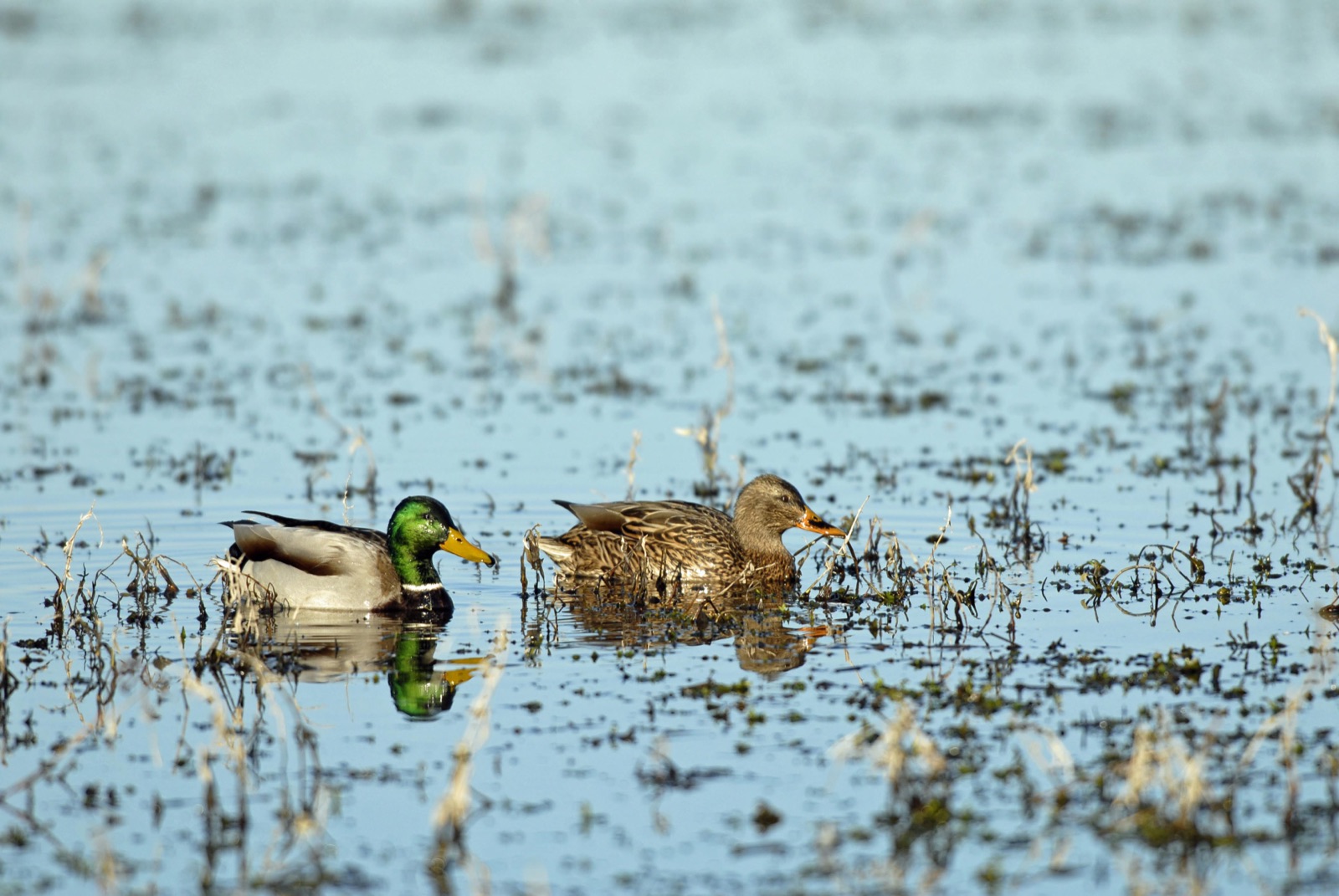
No. The classic quack is the female's voice. A drake usually makes a quieter, raspy one- or two-note call.
Should I call while mallards are flying toward the decoys?
Usually the first choice is to watch. If the flock already holds a useful line, silence preserves that behavior; call only to solve a visible drift or loss of interest.
Is an electronic mallard call legal during duck season?
Generally no under the federal recorded-call prohibition for migratory game birds. Always check the current federal, state, refuge, and property rules for the exact hunt.
Research trail
Sources and further reading
Biology and call context were synthesized into original copy from the following references.