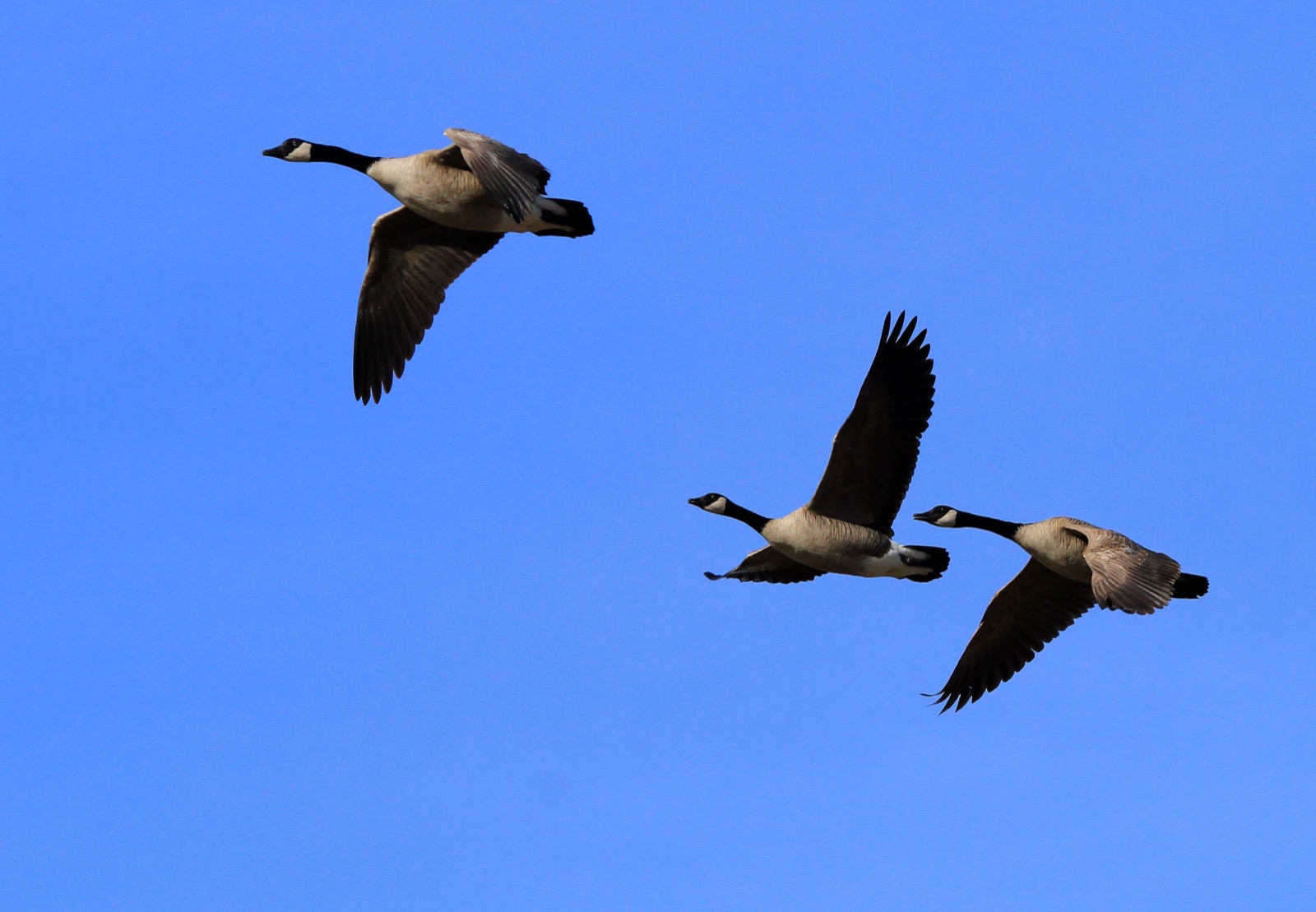
This guide is a short-reed practice plan, not a catalog of the Canada goose's entire natural vocabulary. It starts with the air, tongue movement, and hand pressure needed for one clean cluck, then uses that foundation to shape longer honks and quieter flock sounds. Pitch and cadence still gain meaning from the live flock, distance, and setting.
The Canada goose species guide explains the broader vocabulary and seasonal context. Here the goal is narrower: make a repeatable note, place it inside a simple response drill, and leave room for the geese to answer. A useful practice sequence changes when the birds turn, slide, or hold a landing line instead of filling the entire flight with sound.
What to carry into the field
- Master the cluck first because its clean two-part break supports many other goose sounds.
- Use the longer honk for reach, then reduce projection after the flock acknowledges the setup.
- Blend slower moans and soft murmurs into close-range flock talk rather than treating them as magic finishing calls.
- Match visible and audible flock energy, but stop when geese are descending on a useful line.
Field principle
The cluck is the foundation, not the whole conversation
A cluck is a compact note with a distinct change or break between its low and high portions. On a short-reed call, it depends on fast supported air, tongue control, and hand back-pressure rather than cheek puffing. Practice one note at several quiet-to-moderate volumes before linking clucks. Speed only becomes useful after each break remains clear.
Wild geese do not repeat an identical cluck at an identical interval for an entire approach. Vary small details in pitch, spacing, and direction while keeping the message coherent. One caller can make a few separated notes; a second caller, when coordinated, can answer rather than doubling every sound. The result suggests a group more naturally than one nonstop metronome.
Field principle
How the honk, moan, and murmur change the texture
A honk stretches the basic two-part shape and projects a recognizable contact sound across more distance. A moan is longer and less sharply broken, while the hunter's murmur or feeding-talk label describes softer, low flock sound around resting or feeding birds. These are useful functional descriptions, not a complete translation of every natural Canada goose vocalization.
Use the honk to reach, not merely to be loud. Moans can slow an excited string and add depth, while subdued murmurs belong closer to a settled decoy scene. The size of the spread and the behavior it represents should support the sound: a few relaxed decoys in a quiet pocket should not sound like a large, highly agitated flock.
Field principle
Build a sequence that changes with the flock
For passing birds that have not acknowledged the spread, start with several shaped honks or firm clucks, then pause. If the flock turns or answers, shorten the notes and lower the volume. When geese reach the outer turn, a small group of clucks or one moan can maintain contact. On the inward line, soft notes or silence usually preserve attention for the visual setup.
If the birds begin sliding away, one brief increase in tempo can test whether sound corrects the line. If they turn back, soften immediately; if they keep leaving, continuous calling cannot repair poor concealment, an unsuitable field, glare, or a landing area they distrust. Quiet geese may also prefer a quiet response, so matching the flock does not always mean matching maximum volume.
Field principle
Make the source believable and check current regulations
Build an into-the-wind landing lane that lets geese inspect the decoys without staring directly at uncovered callers. Keep movement controlled and assign one person to lead the cadence. Calling behind birds on the useful part of a turn can be less conspicuous than projecting directly at faces and wings, but the exact choice still depends on wind, terrain, and what the flock does next.
Canada geese are migratory game birds. Federal restrictions generally cover recorded or electrically amplified bird calls, with defined exceptions that do not create a universal permission. Special Canada-goose seasons can have their own dates and methods, while states and properties may add rules. Check the current federal, state, refuge, and land-manager sources for the precise season, place, species, and calling device; this page is educational, not legal advice.
Practice block
The honk-to-ground-talk drill
- Produce five separated clucks with clean breaks, then three longer honks without adding speed.
- Make one attention phrase, pause for five seconds, and answer it with slower clucks and a single moan.
- Have a partner call out turning, sliding, committed, or flaring; change cadence and volume only once in response.
- Finish every scenario with a full silent interval while tracking the imagined landing line and caller movement.
Questions readers ask
Canada goose calling practice FAQ
What Canada goose call should I learn first?
Learn a clean cluck. Its two-part break teaches air, tongue, and hand coordination, and it can be lengthened toward a honk or grouped into more excited phrases later. A reliable single cluck is more useful than several advanced sounds with unclear breaks.
What is the difference between a goose honk and a cluck?
Both share a two-part character, but the honk is longer and generally carries farther, while the cluck is shorter and more compact. Pitch, spacing, volume, and context change how each functions; neither label guarantees a particular flock response.
Should I keep calling when geese are committed?
Usually reduce the volume sharply or stop when the flock is descending on a stable line. If birds begin to slide at the outer edge, one brief phrase may help, but continuous close-range calling can focus attention on the blind instead of the landing area.
Research trail
Sources and further reading
This guide draws on the behavior, calling practice, safety, and equipment context relevant to its subject from the references below.