Direct answer
What snow goose calls mean in the field
Calling cannot compensate for being off the birds' route or competing with thousands of live geese. Scout first, keep the sound centered on the intended landing area, and separate regular-season manual calling from the narrow seasons where electronic calls are actually authorized.
| Call or cue | What it communicates | Best context | Main risk |
|---|---|---|---|
| Adult nasal honk | The species' main year-round contact voice and the basic sound within a snow goose flock. | As the core manual note in any legal calling setup, especially when addressing a lead bird rather than trying to out-volume the whole flock. | Identical honks repeated at one volume sound like a loop. Natural flocks contain overlapping birds and constant small differences. |
| Juvenile whistle | Age-specific family and flock communication that adds a lighter voice among adult nasal notes. | As occasional variation in a legal, mixed-age flock presentation rather than as the dominant sound. | Do not fill an entire sequence with juvenile whistles if the visual spread and season do not suggest many young birds. |
| Family feeding notes | Short-range contact among related birds moving together on the ground. | Softly near the intended landing zone after birds are close enough that a loud flight chorus would be excessive. | Feeding sound should appear to come from feeding birds, not from an exposed hunter or a speaker far outside the spread. |
| Brood-gathering notes | Close family coordination, not a general long-range migration call. | Primarily as a sound to recognize and understand. It is not a standard hunting-season attention call. | Do not disturb nesting or brood-rearing birds. Hunting seasons and conservation orders occur away from the normal Arctic nesting context. |
| Alarm call | Warning to nearby geese; alert lookouts may trigger a much larger flock to take flight. | As a diagnostic sound to recognize, not as a routine intended to make a setup seem safe. | If wild geese begin alarming, look for movement, an exposed blind, a predator, or another safety issue instead of increasing call volume. |
| Layered flight chorus | A hunter-arranged flock impression based on the continuous chorus of traveling snow geese. | Manually during a legal regular season, or electronically only in a specifically authorized light-goose-only season or conservation order. | High volume is not a substitute for correct location. Electronic playback is illegal outside the exact federal and state exceptions that authorize it. |
Vocabulary & use
Snow Goose calls, one by one
Adult nasal honk
Natural vocalization- Sound
- A nasal one-syllable honk made by both sexes on the ground and in flight.
- Meaning
- The species' main year-round contact voice and the basic sound within a snow goose flock.
- When it fits
- As the core manual note in any legal calling setup, especially when addressing a lead bird rather than trying to out-volume the whole flock.
- How to make it
- Use a snow goose mouth call to produce a short nasal squawk with small changes in pitch and intensity between notes.
- Likely response
- A nearby goose may answer or look toward the source; a high moving flock may continue without altering course.
- Do not miss
- Identical honks repeated at one volume sound like a loop. Natural flocks contain overlapping birds and constant small differences.
Juvenile whistle
Natural vocalization- Sound
- A clearer, higher-pitched whistle characteristic of birds less than a year old.
- Meaning
- Age-specific family and flock communication that adds a lighter voice among adult nasal notes.
- When it fits
- As occasional variation in a legal, mixed-age flock presentation rather than as the dominant sound.
- How to make it
- Use a higher pitch and cleaner tone than the adult squawk, leaving it isolated enough to remain distinguishable.
- Likely response
- It may make the sound picture more consistent with a family flock; it should not be expected to turn birds by itself.
- Do not miss
- Do not fill an entire sequence with juvenile whistles if the visual spread and season do not suggest many young birds.
Family feeding notes
Natural vocalization- Sound
- Guttural, lower notes exchanged by family groups while feeding.
- Meaning
- Short-range contact among related birds moving together on the ground.
- When it fits
- Softly near the intended landing zone after birds are close enough that a loud flight chorus would be excessive.
- How to make it
- Create irregular clusters of subdued guttural notes with gaps and overlapping pitches rather than a continuous roar.
- Likely response
- Working birds may continue evaluating the spread; visual motion and flock placement often matter more at this stage.
- Do not miss
- Feeding sound should appear to come from feeding birds, not from an exposed hunter or a speaker far outside the spread.
Brood-gathering notes
Natural vocalization- Sound
- A fast, quiet series used by parents to gather goslings.
- Meaning
- Close family coordination, not a general long-range migration call.
- When it fits
- Primarily as a sound to recognize and understand. It is not a standard hunting-season attention call.
- How to make it
- Study verified wild recordings rather than assigning a commercial label to the sound. If represented at all, keep it quiet and brief.
- Likely response
- Family members may orient to one another; unrelated migrating flocks should not be expected to respond predictably.
- Do not miss
- Do not disturb nesting or brood-rearing birds. Hunting seasons and conservation orders occur away from the normal Arctic nesting context.
Alarm call
Natural vocalization- Sound
- A penetrating call that increases in intensity with the perceived threat.
- Meaning
- Warning to nearby geese; alert lookouts may trigger a much larger flock to take flight.
- When it fits
- As a diagnostic sound to recognize, not as a routine intended to make a setup seem safe.
- How to make it
- Do not add alarm notes to an attraction sequence. Learn their sharper intensity so they can be distinguished from ordinary flock noise.
- Likely response
- Birds may raise their heads, bunch, climb, or leave the area.
- Do not miss
- If wild geese begin alarming, look for movement, an exposed blind, a predator, or another safety issue instead of increasing call volume.
Layered flight chorus
Hunter calling routine- Sound
- Overlapping adult honks, higher juvenile whistles, hoarse squawks, and brief gaps that resemble a flock in motion.
- Meaning
- A hunter-arranged flock impression based on the continuous chorus of traveling snow geese.
- When it fits
- Manually during a legal regular season, or electronically only in a specifically authorized light-goose-only season or conservation order.
- How to make it
- Place the loudest sound within the visual flock, vary the layers, and lower the volume as birds approach. With multiple manual callers, assign different voices.
- Likely response
- A flock may look, descend for another pass, or ignore the setup entirely if its route or destination is elsewhere.
- Do not miss
- High volume is not a substitute for correct location. Electronic playback is illegal outside the exact federal and state exceptions that authorize it.
Seasonal context
When the message is believable
Fall migration
Use manual calls only unless a specific lawful exception applies. Focus on scouting fresh flight lines and give lead birds short, varied flock talk.
Winter and late regular season
Avoid competing with massive live concentrations. Use lower sound density, precise concealment, and locations birds already want to inspect.
Spring conservation order
Electronic calls and other special methods may be allowed under the specific order. Confirm dates, boundaries, species, land rules, and equipment before relying on that exception.
Field sequences
Two restrained ways to build the conversation
These are decision frameworks, not guaranteed formulas. Shorten, soften, or stop when the animal gives new information.
Sequence 01
Manual lead-bird conversation
A regular-season flock crosses within hearing range where only manual calling is lawful
- Give three varied adult nasal honks toward the lead edge of the flock.
- Pause and watch for a head turn or bank.
- If the flock looks, add two softer squawks and one higher juvenile note.
- Let the birds complete a pass before deciding whether another brief phrase has a purpose.
Stop or change when: The flock turns toward the spread, holds a steady migration line without reacting, or climbs after inspecting the setup.
Sequence 02
Legal conservation-order sound pocket
An authorized light-goose conservation order where current rules explicitly permit electronic calls
- Confirm the exception and place the speaker sound within the visual flock before hunting begins.
- Run a varied, moderate flock bed rather than beginning at maximum volume.
- When birds start a lower pass, reduce the level and use a few manual one-note squawks toward the lead bird.
- Keep the landing pocket audible but avoid abrupt track changes while geese are directly overhead.
Stop or change when: Birds are working the landing pocket, begin climbing or sliding away, or any uncertainty arises about season, boundary, or equipment legality.
Before the first note
Field setup
- Scout the current roost-to-feed movement; snow goose calling is secondary to being on a route birds are already using.
- Keep the strongest sound inside or just upwind of the intended landing pocket so birds see a plausible source.
- Use terrain and full concealment because lead adults often inspect the entire spread from above before descending.
- Do not set close to a huge live flock and expect more volume to win; move to a travel corridor or a different destination when access allows.
Read the animal
What the response is telling you
- Lead birds turn their heads and the flock widens or begins a new circle instead of holding a straight migration line.
- A small group breaks lower from the main body, giving a clearer indication than the movement of the entire flock.
- Birds lower their feet or slow wingbeats near the upwind side, showing interest in the landing pocket.
- The flock climbs, stretches into a line, or slides around the spread after a close look, pointing to pressure or a visual mismatch.
Common errors
What makes the setup less believable
Trying to out-call real geese
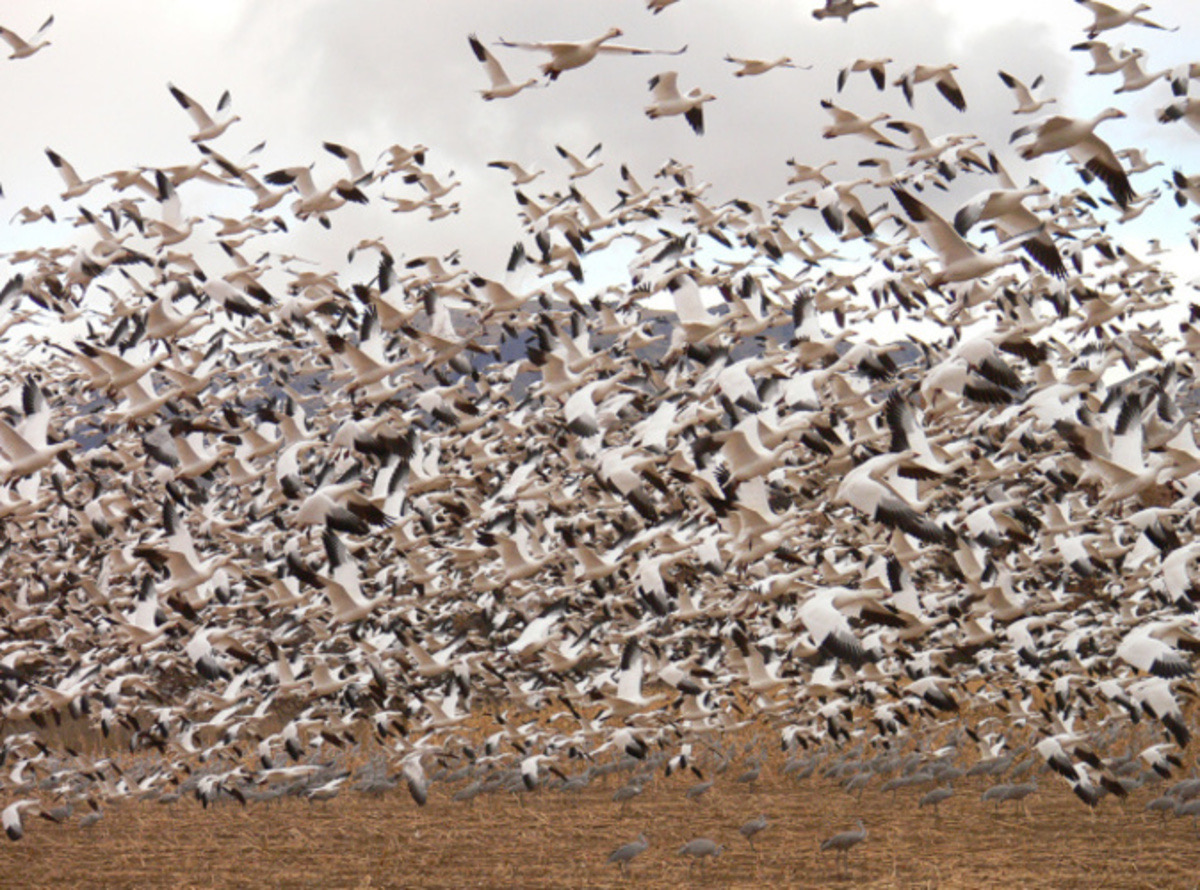
Thousands of live birds provide more convincing sight and sound than any rig. A different route or destination is a better correction than more volume.
Using one loud loop
Snow goose sound contains adult, juvenile, flight, and family voices. A fixed track at fixed volume can expose the source as birds get close.
Applying conservation-order rules to the regular season
The electronic-call exception is tied to specific light-goose-only periods or orders. It does not carry into ordinary duck or goose seasons.
Rules & ethics
Verify before the hunt
Snow geese are migratory game birds. Under 50 CFR 20.21(g), recorded or electrically amplified bird calls are generally prohibited, but the restriction does not apply during a light-goose-only season when all other waterfowl and crane seasons are closed. Conservation-order implementation, dates, boundaries, land access, shooting hours, limits, and special methods vary by state or tribe. Verify every current federal, state, tribal, refuge, and property rule before using electronic equipment.
Hunting-call laws vary by state, species, season, land type, and device. Verify the current wildlife-agency regulations for the exact hunt before using any recorded, amplified, or electronic call.
Electronic-call rules checklist →Questions hunters ask
Snow Goose calling FAQ
Are electronic snow goose calls always legal in spring?
No. They are lawful only under an applicable light-goose-only season or conservation order and the implementing state, tribal, refuge, and property rules.
What is the main natural snow goose call?
Both sexes use a nasal one-syllable honk throughout the year. Juveniles add clearer whistles, and family groups exchange lower feeding notes.
Will louder calling make a high flock descend?
Not reliably. Volume may get attention in wind, but route, altitude, fresh birds, visual spread, and competition from live flocks usually matter more.
Research trail
Sources and further reading
Biology and call context were synthesized into original copy from the following references.